

Motorcycle Club Safety Briefing Checklist for Every Ride
Every group ride that goes sideways can usually be traced back to one thing: nobody ran a proper safety briefing before kickstands went up. A solid motorcycle club safety briefing checklist is your crew’s first line of defense against chaos on the asphalt, and the Motorcycle Safety Foundation has been preaching this gospel for decades. Think of it as the pre-flight checklist that keeps your iron birds in the air. Skip it, and you’re basically winging it at 70 mph with a pack of fellow knights of the asphalt jungle.
Here’s the full checklist your Road Captain should run through before every group ride:
- Meeting time and location confirmed, with the briefing completed within 15 minutes of departure
- Leadership roles assigned: Lead rider, Sweep (Tail Gunner), and any intermediate Road Captains
- Route overview delivered, including turn-by-turn highlights, known hazards, and construction zones
- Planned stops announced: gas, rest, and refreshment locations with estimated mileage between each
- Personal protective gear check: helmets, jackets, gloves, boots, and eye protection confirmed on every rider
- Hand and arm signals reviewed with the full group, including how to pass signals back through the pack
- Formation riding rules explained: staggered formation with a 1-second following interval, and single-file with a 2-second gap for curves or poor visibility
- No-passing rule stated clearly: riders do not pass each other within the group under any circumstances
- Emergency and accident protocols covered: who calls 911, who handles first aid, who controls traffic
- Separation procedures explained: if you get split from the group, continue safely to the next planned waypoint without speeding to catch up
- Weather and road condition update given based on current forecasts and any route-specific hazards
- Mechanical failure plan outlined: Sweep stops with any rider in distress; support vehicle coordinates assistance
- Communication methods confirmed: radio channels, phone numbers, and distraction policies for mobile devices
- Alcohol and substance policy restated: zero tolerance, full stop
That’s the spine of every great group ride briefing. The sections below break each item open so your Road Captain can run it with confidence, and every rider in your pack knows exactly what to expect.
1. Pre-ride preparation and clear role assignments
Before anyone throws a leg over a seat, the pre-ride phase is where the real safety work happens. A Road Captain who shows up 30 minutes early and runs a tight pre-ride check is worth their weight in gold. One who wings it? Well, that’s how you end up with a blown tire at mile 40 and no one carrying a patch kit.
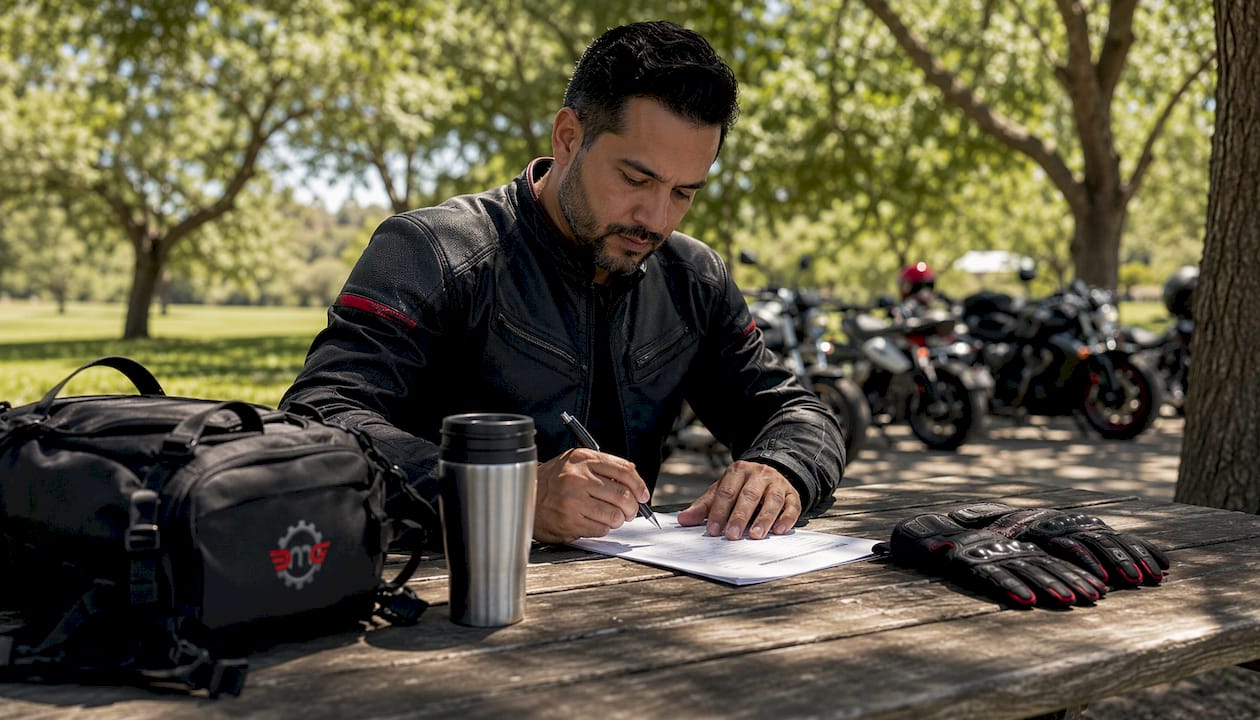
Mechanical and safety inspections are non-negotiable. The T-CLOCS framework (Tires, Controls, Lights, Oil, Chassis, and Kickstand) gives every rider a fast, structured way to confirm their bike is road-ready. A thorough motorcycle safety inspection covers tires for pressure and tread depth, brakes for responsiveness, fluid levels, and all lights front and rear. If something looks sketchy, it gets fixed before the group rolls, not after.
Role assignments need to happen out loud, in front of everyone:
- Lead Rider (Road Captain): Sets the pace, navigates the route, monitors all riders ahead and in mirrors, and manages the group’s overall safety. Rides in the left third of the lane.
- Sweep (Tail Gunner): Rides last, monitors the rear, stops with any rider experiencing trouble, and signals the Lead when the group is fully assembled and ready. Required to carry a cell phone, first-aid kit, and tool kit.
- Intermediate Road Captains: Positioned throughout larger groups (12 or more bikes) to relay signals and manage sub-groups.
- Support Vehicle: Carries extra gear, tools, and can transport a rider or bike if someone can’t complete the ride.
Rider placement matters more than most clubs admit. New or less experienced riders should be positioned directly behind the Lead, where the Road Captain can monitor them closely and set a manageable pace. Putting a new rider at the back of a 20-bike pack is a recipe for pressure and panic.
Gas stop planning is one of those details that sounds boring until it isn’t. Schedule fuel stops based on the bike with the smallest fuel tank in the group. That Sportster in the third position isn’t going to magically grow a bigger tank because everyone else is comfortable. Plan around the smallest range, and unplanned roadside scrambles stay off the itinerary.
Physical and mental readiness deserves a mention too. Riders who are fatigued, dehydrated, or under the weather are a hazard to themselves and everyone around them. On hot days, the Road Captain should remind the group to hydrate at every stop. A quick “how’s everyone feeling?” before departure costs nothing and can catch a problem before it becomes an emergency.
Alcohol and substance policy gets stated at every briefing, no exceptions. Zero tolerance means zero. Riders who have consumed alcohol at a lunch stop are done riding with the group for that day, full stop.
2. Communication protocols and hand signals during group rides
Hand signals are the language of the pack, and if half your riders don’t know the vocabulary, you’ve got a communication breakdown waiting to happen at the worst possible moment. The MSF’s group riding guide puts it plainly: every rider uses the same signals and passes them back through the group. That relay system is what keeps 15 bikes moving like one organism instead of 15 confused individuals.
Core hand and arm signals every rider must know:
- Left turn: Left arm extended straight out
- Right turn: Left arm bent upward at the elbow, fist closed
- Stop: Left arm extended down, palm facing rearward
- Speed up: Left arm extended, palm facing upward, sweeping motion upward
- Slow down: Left arm extended, palm facing downward, sweeping motion downward
- Hazard on left: Left foot pointed down toward the road
- Hazard on right: Right foot pointed down toward the road
- Single file: Left arm raised, index finger pointing up
- Staggered formation: Left arm raised, index and middle fingers spread in a V
- Pull off / stop ahead: Left arm raised, fist closed, then pointing to the side of the road
- Fuel stop needed: Left hand pointing to tank with tapping motion
- Comfort stop: Fist clenched, arm moving up and down (the universal “I need a bathroom” signal that everyone understands immediately)
Passing signals back is the rule, not the suggestion. When the Lead signals a hazard or a turn, every rider repeats that signal to the rider behind them. The signal travels from front to back like a wave. If you’re too busy to safely take a hand off the bars, skip the signal and keep both hands on the controls. Safety always beats courtesy.
Radio and mobile phone policies need to be addressed before the ride, not during it. Bluetooth intercoms (like those using FMRS or dedicated motorcycle communication systems) are the preferred tool for Lead-to-Sweep communication on longer rides. The CVMA Road Captain Manual recommends establishing a central contact number for someone not on the ride who can relay separation or breakdown calls to leadership. Handheld phone use while riding is off the table entirely.
Separation communication deserves its own moment in the briefing. If part of the group gets split at a light or intersection, the Lead slows or stops at a safe location to allow regrouping. Riders who find themselves temporarily leading a sub-group should pull over safely (on a hard surface, never a median or soft shoulder) and wait for the Tail Gunner to assume the lead position. Nobody speeds. Nobody panics.
Pro Tip: Before the ride, do a quick 60-second signal review where the Road Captain performs each signal and the group repeats it back. It takes less than a minute and eliminates the “wait, what does that mean?” moment at 65 mph.
3. Formation riding rules and safe group spacing
Staggered formation is not just a suggestion from people who like geometry. It’s the configuration that gives every rider in the pack enough space to react, swerve, and survive a surprise. The MSF’s formation standard is clear: the Lead rides in the left third of the lane, the next rider positions one second behind in the right third, and the pattern continues down the line. That offset gives each rider a full lane width of maneuvering room while keeping the group tight enough to function as a unit.
Staggered formation rules:
- Lead rider: left third of the lane
- Second rider: right third of the lane, minimum 1-second following distance behind the Lead
- Third rider: left third, minimum 1-second behind the second rider
- Pattern continues alternating left-right down the pack
- Never ride directly beside another rider (side-by-side is banned; handlebar entanglement is not a fun way to end a Saturday)
Single-file formation applies in specific situations, and the Lead signals the switch:
- Curvy or winding roads
- Poor visibility conditions (fog, rain, dusk)
- Poor road surfaces (gravel, debris, construction zones)
- Entering or exiting highways
- Narrow roads or bridge crossings
In single file, the minimum following distance increases to 2 seconds, giving each rider the full lane width and adequate reaction time. That 2-second gap sounds small but translates to meaningful stopping distance at highway speeds.
Filling gaps when a rider leaves the group is handled by criss-crossing into the next vacant position, not by the column directly behind the gap moving straight forward. Passing another rider within the lane to close a gap carries real collision risk, and the MSF specifically advises against it.
Speed management is the Lead’s responsibility, and it’s one of the trickiest parts of the job. The Lead should accelerate smoothly, avoid shooting into gaps that the full pack can’t follow through, and check mirrors regularly. If a rider is falling behind, the Lead slows to let them catch up. The goal is a steady group speed without anyone feeling pressured to ride beyond their comfort level.
No passing within the group is the rule that Road Captains enforce most strictly. Passing inside the group disrupts the stagger, breaks the visual rhythm every rider depends on, and creates exactly the kind of unpredictable movement that causes collisions. If a rider genuinely needs to pass traffic, the group goes single file and passes one at a time.
Three-wheeled bikes (trikes) ride at the rear of the formation in staggered position with the 2-second rule applied. Support vehicles (cages) always form a separate sub-group, never integrated into the motorcycle formation.
4. Accident and emergency procedures for group rides
Nobody wants to think about this part. But the clubs that handle emergencies well are the ones that planned for them before they needed to. The moment an incident happens, clear roles prevent the bystander effect from turning a bad situation into a catastrophic one.
Immediate actions after an accident:
- Move involved bikes off the roadway as quickly and safely as possible
- Activate 4-way flashers on any bikes or support vehicles near the scene
- Limit the number of people at the crash site to allow emergency responders clear access
- Keep the rest of the group staged safely away from traffic
Role delegation is the key move. Assigning distinct emergency functions immediately prevents everyone from standing around waiting for someone else to act. The Road Captain or Sweep designates:
- 911 caller: One person makes the call, gives location, describes injuries, and stays on the line
- First aid provider: The rider with first-aid or CPR training takes charge of the injured party
- Traffic control: One or two riders position themselves to warn approaching traffic (using flashers and hand signals, not by standing in the road)
- Incident recorder: Documents time, location, parties involved, and any witness information for insurance and legal purposes
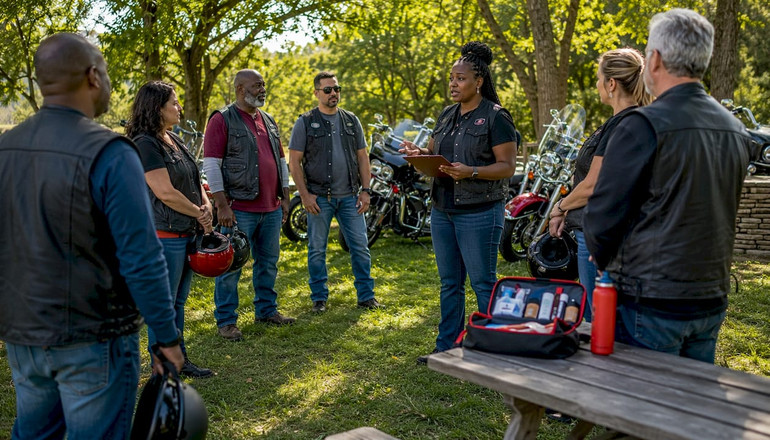
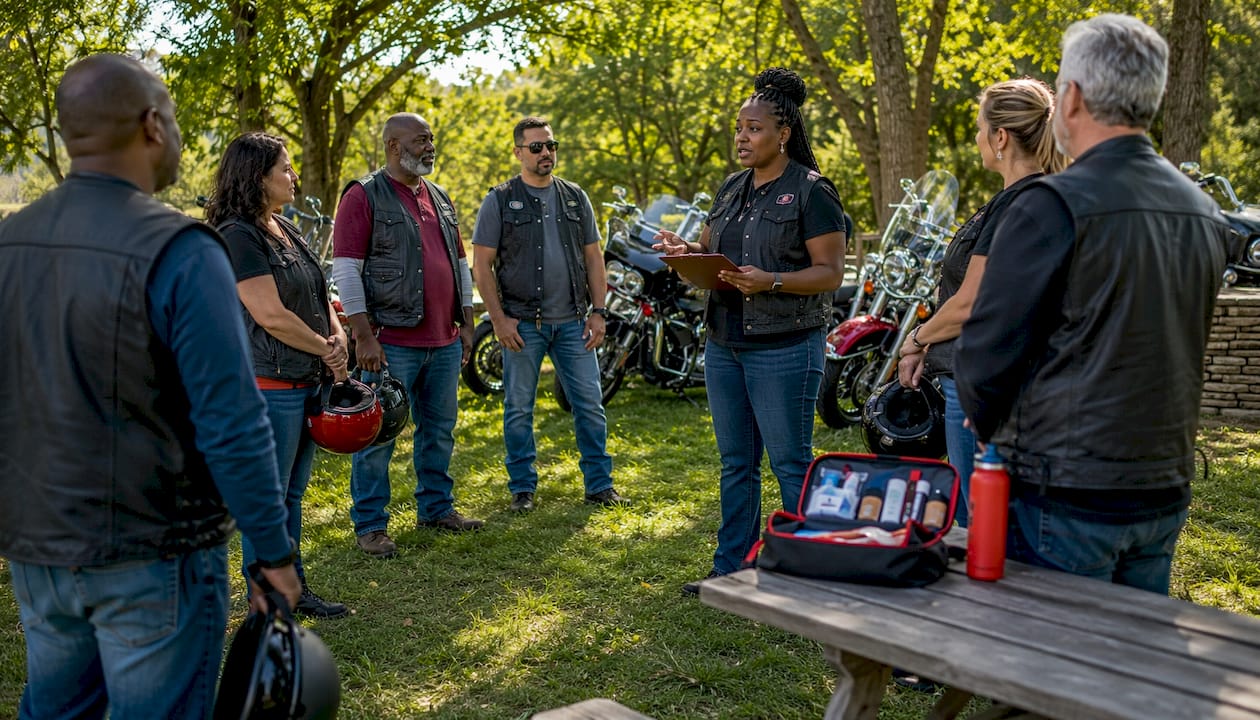
First-aid readiness starts at the briefing. The Road Captain should ask at every pre-ride meeting whether any riders hold first-aid, CPR, or EMT certification and whether they’re willing to assist in an emergency. At least one rider per group should carry a first-aid kit, and the Sweep’s kit is mandatory. The American Legion Riders’ safety handbook notes that a standard drugstore first-aid kit won’t cut it for motorcycle injuries; riders need kits sized and stocked for trauma, burns, and fractures.
Separation and regroup protocols after an incident follow the same logic as any other separation. Riders not directly involved in the emergency continue safely to the next planned waypoint without speeding or making risky maneuvers to catch up. The Sweep stays with the incident until emergency services arrive or the situation is resolved. The last rider in the remaining group assumes Sweep duties automatically.
Mechanical failures follow a similar playbook. The Sweep stops with the rider experiencing the breakdown. The Lead is notified (via radio or phone) and finds a safe location to hold the group. The support vehicle moves to assist. If the bike can’t be fixed roadside, most stops on organized rides can store a motorcycle overnight, and the support vehicle transports the rider.
Tool kit availability should be confirmed at the briefing. Road Captains and Sweeps typically carry extensive kits. Every rider is encouraged to bring their own. Knowing who has SAE versus metric tools in the pack can save a lot of time when something needs tightening at mile 80.
5. Critical safety rules and the culture that makes them stick
Rules on paper are only as good as the culture that enforces them. The clubs that ride safely year after year aren’t just following a checklist; they’ve built a shared identity around looking out for each other. That starts with the Road Captain and radiates outward through every rider in the pack.
“Ride your own ride” is the foundational philosophy. Every rider is ultimately responsible for their own safety. If a formation feels too tight, a pace feels too fast, or a road condition feels sketchy, any rider has the right and the responsibility to pull out of formation safely without judgment from the group. The briefing should state this explicitly: pulling back is not weakness, it’s wisdom. Riders who feel empowered to make that call are far less likely to push beyond their limits and create a problem for everyone.
No-passing enforcement falls squarely on the Road Captain. Passing within the group disrupts the stagger, creates unpredictable movement, and has been identified as a leading cause of group ride accidents. The Lead sets a pace that doesn’t pressure anyone, and if the pace is right, there’s no reason anyone needs to pass.
Identifying and mentoring new riders is a cultural act, not just a logistics task. New riders placed behind the Lead get more than a safe position; they get a front-row view of how an experienced Road Captain reads traffic, manages pace, and signals the group. That’s real-time education. Experienced riders near new members in the formation can offer quiet encouragement at stops and flag concerns to the Road Captain without embarrassing anyone.
Zero tolerance for alcohol and impairment is non-negotiable and needs to be stated at every briefing, not assumed. Riders who consume alcohol at a lunch stop are done for the day. Passengers who become intoxicated end the rider’s participation too, because an impaired passenger affects the bike’s handling and the rider’s focus. No exceptions, no negotiations.
Defensive riding and situational awareness round out the cultural piece. Riders should scan well ahead, not fixate on the bike directly in front of them. Watch for the car edging out at the next intersection, the stale green light about to change, the driver weaving while on a phone. The Road Captain sets the tone by modeling this awareness visibly, and the group follows.
Pro Tip: When delegating emergency roles at the briefing, name specific people for specific jobs rather than asking for volunteers. “Marcus, you’re our 911 caller if anything happens. Jenna, you’ve got first aid.” Named assignments prevent the bystander effect cold, because everyone knows exactly what they’re responsible for.
Behavior standards extend beyond safety mechanics. Road Captains and club officers should actively discourage inappropriate behavior from any rider, whether they’re a club member or a guest. The group represents the club’s reputation on every public road it travels. That’s worth stating plainly at the briefing, especially on rides that include newer members or guests who may not know the club’s standards yet.
Health and fitness are easy to overlook in a safety briefing, but fatigue and dehydration cause real impairment. Riders who are sleep-deprived, ill, or physically depleted should sit out. The Road Captain can frame this positively: “We want everyone back for the next ride, so if you’re not feeling 100%, there’s no shame in calling it today.” Checking in on rider comfort and ergonomics during stops also helps catch fatigue before it becomes a problem on the road.
Weather and road condition updates belong in every briefing, not just when the sky looks threatening. The Road Captain checks forecasts before departure and identifies any route-specific hazards: construction zones, known gravel patches, bridge grating, or areas prone to standing water. Seasonal weather conditions can change a planned route entirely, and the Road Captain has full authority to modify the route based on real-time conditions. Riders should know this authority exists and trust it.
Gear compliance gets a visual check at the pre-ride, not just a verbal reminder. Every rider should be wearing a helmet (full-face or at minimum DOT-rated), jacket with armor or abrasion resistance, gloves, over-the-ankle boots, and appropriate pants. The right protective gear is the last line of defense when everything else goes wrong. A Road Captain who spots a rider in flip-flops and a t-shirt has every right to address it before the group rolls.
Key Takeaways
A properly run motorcycle club safety briefing checklist, completed within 15 minutes of departure, is the single most effective tool a Road Captain has for preventing accidents, confusion, and chaos on a group ride.
| Point | Details |
|---|---|
| Brief within 15 minutes of departure | Complete the full safety briefing within 15 minutes before kickstands up, covering route, roles, signals, and emergency protocols. |
| Assign roles out loud | Name the Lead, Sweep, and any intermediate Road Captains explicitly so every rider knows who to follow and who to flag in an emergency. |
| Staggered vs. single-file spacing | Maintain at least a 1-second following interval in staggered formation, and increase to a 2-second gap in single-file on curves, highways, or during poor-visibility conditions. |
| Delegate emergency roles by name | Assign specific riders to call 911, provide first aid, control traffic, and document the incident to prevent bystander paralysis. |
| “Ride your own ride” is a rule, not a suggestion | Any rider may pull safely out of formation if they feel overwhelmed, and the group culture must support that decision without judgment. |
Recommended
- Staying Safe and Stylish on the Track: The Importance of Proper Motorcycle Gear - DMG Motorsports
- 6 Top Beginner Motorcycle Accessories for New Riders - DMG Motorsports
- Motorcycle Weather Riding Tips for Every Season - DMG Motorsports
- Motorcycle Service Explained: Boosting Performance and Safety - DMG Motorsports