

Motorcycle Ergonomics: Rider Comfort and Control Guide
Motorcycle ergonomics is defined as the systematic relationship between a rider’s body and three contact points on the bike: the seat, handlebars, and footpegs. Together, these three points form what experts call the rider triangle, and that triangle governs everything from how well you corner to how your back feels after hour three on the highway. Get it right, and riding feels effortless. Get it wrong, and you’re white-knuckling through fatigue before you hit the halfway point. Whether you’re a weekend warrior or a daily commuter, understanding what is motorcycle ergonomics is the single most useful thing you can do for your riding.
What is the rider triangle and why does it matter?
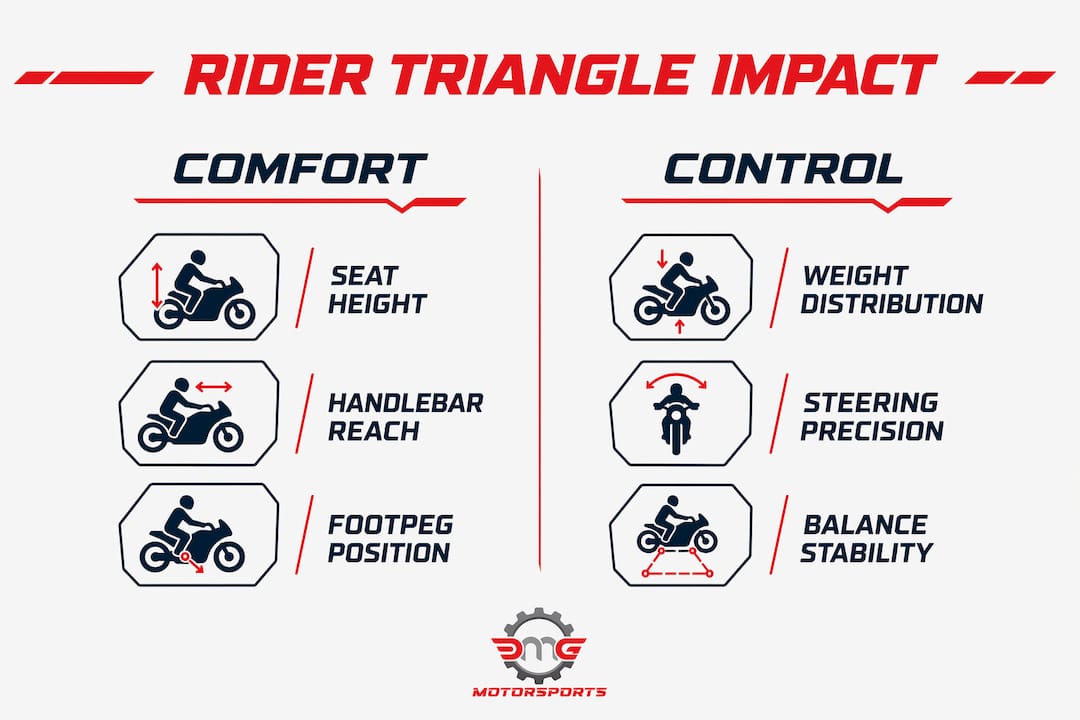
The rider triangle is the geometry formed by your three contact points with the motorcycle: where you sit, where your hands rest, and where your feet land. Each point carries a share of your body weight and shapes your posture. Shift any one of them, and the whole system changes.
How each contact point affects your posture
Your seat position sets your hip angle and spine alignment. A seat that’s too low forces your knees up and compresses your lower back. A seat that’s too high puts your weight on your tailbone and makes low-speed maneuvering sketchy. Your handlebars control how far you lean forward and how much weight your wrists and shoulders carry. Bars that are too far away lock your elbows and strain your shoulders within minutes. Your footpegs determine your knee bend and how much leg muscle you can use to stabilize the bike. Pegs that are too far forward push your hips back and wreck your spine alignment.
The rider triangle directly influences control, balance, and weight distribution. Poor ergonomics increase safety risks by causing fatigue, reducing cornering accuracy, and limiting your ability to react in an emergency. That’s not a minor inconvenience. That’s a safety issue wearing a comfort costume.
| Misalignment | Effect on Rider | Effect on Control |
|---|---|---|
| Seat too low | Hip compression, lower back pain | Reduced ground clearance awareness |
| Bars too far forward | Locked elbows, shoulder strain | Less steering input precision |
| Footpegs too forward | Spine misalignment, hip slide | Reduced leg bracing ability |
| All three misaligned | Full-body fatigue within 1–2 hours | Degraded braking and cornering response |
Pro Tip: Sit on your bike in your normal riding position and close your eyes. Notice where tension builds first. That’s your weakest ergonomic link, and it’s the one to fix first.
How does motorcycle ergonomics affect riding comfort and safety?
Ergonomics and safety are the same conversation wearing different hats. Proper ergonomics improves control, vision, braking power, and cornering accuracy, all of which directly affect your ability to avoid accidents. When your body is fighting your bike’s geometry, your brain is spending processing power on pain management instead of reading the road.
Fatigue is the sneaky villain here. Riders who slump their lower back or lock their elbows are burning stabilizer muscles constantly, even on straight roads. Proper core muscle engagement supports upper body weight and prevents back and shoulder fatigue. Using your core reduces reliance on your arms for support, which keeps your hands light on the bars and your steering inputs clean.
Here are the early warning signs that your ergonomic setup is working against you:
- Numb hands or tingling fingers after 20–30 minutes of riding (too much weight on your wrists)
- Lower back ache that builds progressively (seat height or bar reach is off)
- Neck tension or headaches (often wind turbulence from a mispositioned screen, but also bar height)
- Knee pain on longer rides (footpeg position forcing an unnatural leg angle)
- Shoulder fatigue even on relaxed roads (bars too wide or too far forward)
“Waiting for pain or discomfort before adjusting your ergonomics reduces your safety margin. Early ergonomic adjustments improve riding quality and keep you in control before fatigue sets in.”
Wind protection also plays a role most riders overlook. Turbulent airflow causes neck fatigue and tension headaches, and a properly positioned windscreen reduces that load significantly. Less physical noise means more mental focus on the road ahead.
How do ergonomics vary across different motorcycle types?
Not all bikes are built for the same body position, and that’s by design. The ergonomic setup of a motorcycle reflects its intended use. Understanding those differences helps you know what you’re working with before you start making changes.
Sportbikes put you in an aggressive forward lean. Your weight shifts onto your wrists, your knees grip the tank, and your core works hard to keep you from sliding forward under braking. This position is great for track days and fast canyon runs, but brutal on a two-hour highway stretch. The ergonomic design prioritizes aerodynamics and control at speed, not all-day comfort.
Adventure bikes flip the script. An upright seating position keeps your spine neutral, distributes weight evenly across the seat, and gives you a commanding view of the road. They’re built for long days in the saddle, whether on pavement or gravel. The trade-off is a higher center of gravity and a wider, taller stance that takes some getting used to in tight spaces.
Sport touring motorcycles split the difference. They offer a slightly forward lean that stays manageable for hours, with enough wind protection to reduce fatigue. Long-distance comfort depends on an aligned rider triangle, correct suspension preload, and tire pressure matched to load. On a sport tourer, all three of those factors are tunable from the factory.
| Bike Type | Riding Position | Comfort Range | Control Priority |
|---|---|---|---|
| Sportbike | Aggressive forward lean | Short to medium rides | High-speed precision |
| Adventure bike | Upright, neutral spine | All-day capable | Versatility on varied terrain |
| Sport tourer | Mild forward lean | Long-distance optimized | Balanced comfort and control |
| Cruiser | Reclined, feet forward | Medium to long rides | Low-speed stability |
Pro Tip: Suspension preload and tire pressure directly affect your steering geometry and weight distribution. Check both before blaming your seat for a bad ride.
How can riders customize motorcycle ergonomics to their body?
The good news: you don’t need a new bike. Most ergonomic improvements come from targeted adjustments that cost far less than a new motorcycle and deliver results you’ll feel on the very next ride. The key is working through the process systematically rather than throwing parts at the problem.
Here’s a step-by-step approach to dialing in your setup:
-
Assess your current position. Sit on the bike in your normal riding posture. Check that your elbows have a slight bend (not locked), your knees grip the tank without strain, and your spine feels neutral rather than rounded or arched. Take a photo from the side if you can. What you see often surprises you.
-
Start with the seat. The rider triangle setup is the critical factor in preventing riding fatigue, and the seat is its foundation. If your current seat is too soft and compresses under load, a firmer aftermarket option often outperforms a plush one for long rides. Firmer foam maintains consistent support instead of creating pressure points as it bottoms out.
-
Adjust your handlebars. Bar risers are one of the most cost-effective ergonomic upgrades available. Raising your bars by even 20–30mm can transform a punishing forward lean into a comfortable neutral position. Adjustable bar ends and different bar widths also change how much shoulder and wrist strain you carry.
-
Relocate your footpegs. Adjustable footpegs reduce joint stress and improve weight distribution. Moving pegs back slightly on a cruiser or forward on a sportbike can fix knee pain and improve your ability to brace the bike with your legs. This is an underrated adjustment that most riders never try.
-
Make one change at a time. Changing your seat, bars, and pegs simultaneously makes it impossible to know what actually helped. Space your adjustments across a few rides so you can feel the difference each one makes.
-
Ride and reassess. Take a 45-minute ride after each adjustment. Pay attention to where fatigue builds and whether your control inputs feel lighter or heavier. Many riders wrongly treat ergonomics as a parts list rather than a body-bike positioning system. The goal is a setup where your body and the bike work together, not against each other.
Pair these physical adjustments with proper motorcycle gear that fits your riding position. Gear that bunches up or restricts movement can undo ergonomic improvements you’ve worked hard to dial in.
Key Takeaways
Motorcycle ergonomics is a control system first and a comfort system second. Riders who treat it that way ride longer, safer, and with far less physical cost.
| Point | Details |
|---|---|
| Rider triangle is foundational | Seat, handlebars, and footpegs together determine posture, control, and fatigue. |
| Ergonomics directly affects safety | Poor setup reduces cornering accuracy, braking power, and emergency response ability. |
| Bike type sets your baseline | Sportbikes, adventure bikes, and tourers each have distinct ergonomic profiles to understand before modifying. |
| Core engagement reduces fatigue | Using core muscles instead of arm strength keeps steering inputs clean and extends ride duration. |
| Adjust one thing at a time | Sequential changes let you identify what actually improves your comfort and control. |
Why ergonomics is the most underrated safety feature on your bike
Here’s my honest take after years of watching riders spend serious money on accessories while ignoring the one thing that affects every single mile they ride. Ergonomics gets filed under “comfort stuff” in most riders’ minds, and that framing is the problem. Comfort is a byproduct. Control is the actual goal, and a bike set up for control happens to feel comfortable because your body isn’t fighting it.
I’ve seen riders with premium suspension, top-shelf tires, and a closet full of gear who still white-knuckle through long rides because their bars are two inches too far away. That’s not a gear problem. That’s a geometry problem. And geometry is free to fix, or close to it.
The riders who get this right share one habit: they treat ergonomics as an ongoing practice, not a one-time setup. They check in with their body after rides, notice where tension builds, and make small adjustments before discomfort becomes pain. That proactive mindset is what separates riders who improve year over year from those who just accumulate miles and aches. Check out beginner ergonomic accessories if you’re just starting to build your setup. The investment is small. The return is every ride you take from here on out.
— Bryan
Gear up for better ergonomics at Dmgmotorsports
Knowing your rider triangle is half the battle. The other half is having the right gear and accessories to act on it.

Dmgmotorsports carries a full range of ergonomic accessories, from bar risers and adjustable footpegs to performance seats and wind protection solutions, all sourced from top industry brands. Whether you’re fine-tuning a sportbike for track days or setting up an adventure bike for a cross-country run, the Dmgmotorsports catalog has what you need to ride longer, feel better, and stay in control. Our team knows motorcycles, and we’re here to help you find the right fit for your body and your riding style.
FAQ
What is motorcycle ergonomics in simple terms?
Motorcycle ergonomics is the study of how your body interacts with your bike through the seat, handlebars, and footpegs. Getting that relationship right improves comfort, control, and safety on every ride.
How does the rider triangle affect my riding?
The rider triangle determines your posture, weight distribution, and how precisely you can steer and brake. A misaligned triangle causes fatigue and reduces your ability to respond in emergencies.
What are the easiest ergonomic upgrades to make?
Bar risers, adjustable footpegs, and a firmer aftermarket seat are the most accessible starting points. Each one targets a different contact point in the rider triangle and can be added progressively.
Does motorcycle ergonomics matter for short rides?
Yes. Even on short rides, poor ergonomics creates tension in your wrists, shoulders, and lower back that compounds over time. Correct setup reduces physical strain regardless of ride length.
How do I know if my motorcycle ergonomics need adjustment?
Numb hands, lower back pain, neck tension, or knee discomfort after 20–30 minutes of riding all signal that your setup needs attention. Address these signs early rather than waiting for them to worsen.
Recommended
- Motorcycle Gear Fit for Women Riders: 2026 Guide - DMG Motorsports
- Staying Safe and Stylish on the Track: The Importance of Proper Motorcycle Gear - DMG Motorsports
- Motorcycle Jacket Fit Sizing Explained for Riders - DMG Motorsports
- How to Fit a Motorcycle Helmet for Performance and Comfort - DMG Motorsports