


Motorcycle Helmet Safety Ratings Explained for U.S. Riders

Motorcycle helmet safety ratings indicate that a helmet has passed specific impact and protection tests required for rider safety and legal road use in the United States. Three standards dominate the conversation: DOT (FMVSS 218), ECE 22.06, and Snell. Each one tests differently, certifies differently, and protects differently. Understanding those differences is the difference between buying a helmet that looks good on paper and one that actually keeps your skull intact when the asphalt comes up to say hello. This guide breaks down motorcycle helmet safety ratings explained in plain English, so you can shop with confidence and ride with your brain still in working order.
What are the main motorcycle helmet safety standards?
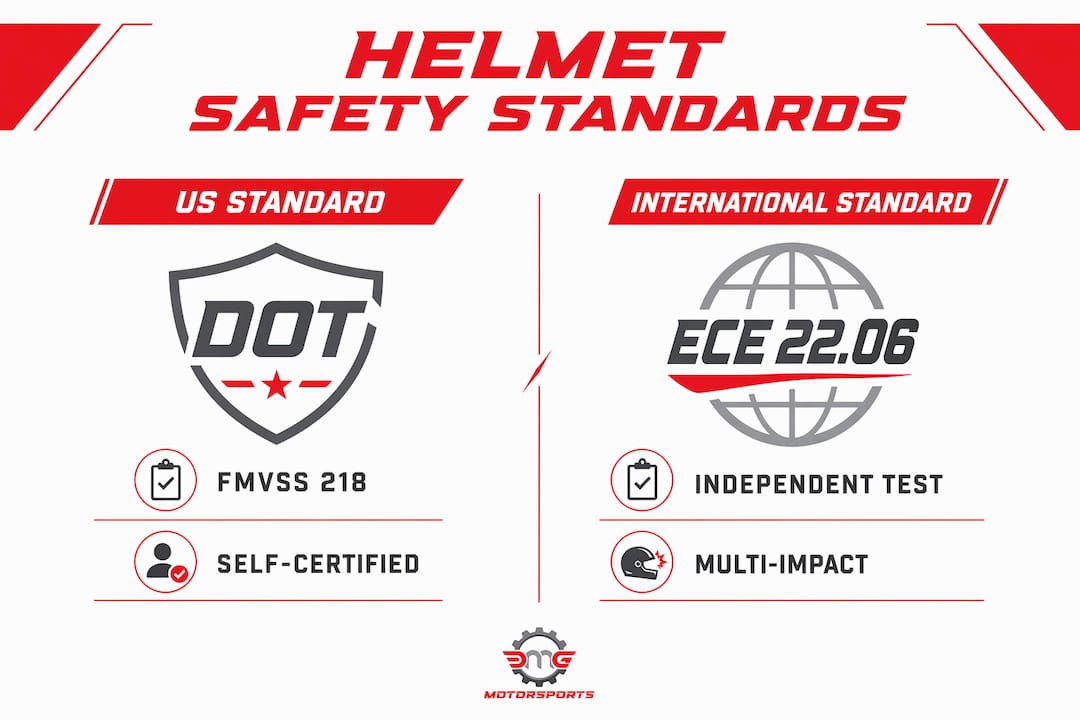
DOT is the legal minimum for helmets sold in the United States. It operates under FMVSS 218, the Federal Motor Vehicle Safety Standard that every helmet manufacturer must meet before putting a DOT sticker on their product. Here is the catch: DOT uses self-certification, meaning the manufacturer tests their own helmet and declares it compliant. NHTSA only conducts post-sale spot checks. That means a DOT sticker tells you the manufacturer claims compliance, not that an independent lab confirmed it before the helmet hit store shelves.
ECE 22.06 is the European standard, and it plays by very different rules. Every helmet must pass independent lab testing before it goes on sale, covering 18–22 impact points and including oblique impact tests that simulate the rotational forces your head experiences in a real crash. That rotational component is a big deal. Most street accidents involve glancing blows, not perfectly vertical drops onto a flat surface. ECE 22.06 accounts for that reality. DOT does not.

Snell is a voluntary, independent certification run by the Snell Memorial Foundation. It focuses on high-energy multi-impact tests and strict penetration resistance. Snell helmets tend to have stiffer EPS liners, which excel at absorbing massive single impacts at track speeds. The tradeoff is that stiffer liners may be less effective on the lower-speed sliding impacts that are far more common in everyday street riding. Snell is the gold standard for track days. For daily commuting, ECE 22.06 may actually serve you better.
Here is a quick breakdown of how the three standards compare:
| Standard | Certification process | Impact testing | Best suited for |
|---|---|---|---|
| DOT (FMVSS 218) | Self-certified by manufacturer | Basic impact, no oblique | U.S. legal minimum, street |
| ECE 22.06 | Independent lab, pre-sale | 18–22 points, oblique impacts | Street riding, real-world crashes |
| Snell | Independent lab, voluntary | Multi-impact, penetration | Track riding, high-speed impacts |
The key takeaway from understanding helmet safety standards is this: passing a certification does not mean all certified helmets are equal. The SHARP program in the UK uses 32 impact tests and rates helmets from 1 to 5 stars. Their data shows up to 70% variance in protection among helmets that all meet minimum legal standards. That variance is enormous. A helmet that barely clears DOT and a helmet that aces ECE 22.06 can sit on the same shelf with the same price tag and wildly different real-world performance.
How do you interpret helmet ratings for everyday riding?
Safety ratings set the floor, not the ceiling. A certified helmet tells you the minimum tested performance level. It does not tell you how that helmet performs in your specific riding environment, at your typical speeds, or against the types of impacts you are most likely to experience.
Fit is the variable that most riders underestimate. A poorly fitting helmet provides less protection in a real crash than a properly fitting helmet that only meets minimum safety requirements. That is not a technicality. Fit affects how the helmet stays on your head during impact, how effectively the liner absorbs energy, and whether the chin strap holds the shell in place when it counts. A helmet that rocks around on your head is not protecting you the way the lab tests assumed it would.
Here is how to think about ratings for different riding contexts:
- Street riders benefit most from ECE 22.06 because it tests the oblique impacts most common in road accidents.
- Track riders should prioritize Snell certification because it targets the high-energy impacts associated with racing speeds.
- Commuters and casual riders need at minimum a DOT sticker for legal compliance, but should look for ECE 22.06 or SHARP ratings for better real-world assurance.
- Budget-conscious riders should use SHARP star ratings as a free, independent filter when comparing helmets at similar price points.
Pro Tip: When shopping for the best rated motorcycle helmets, look for helmets that carry both DOT and ECE 22.06 certifications. That dual certification signals the manufacturer built the helmet to a higher standard than U.S. law alone requires.
The SHARP data point deserves a second look. Up to 70% variance in protection among legally compliant helmets means that buying the cheapest DOT-certified helmet is a genuine gamble. Certification shows compliance with lab test standards, but it does not guarantee optimal real-world protection without proper fit and rider use. Treat the rating as your starting point, not your finish line.
When should you replace your motorcycle helmet?
Helmet manufacturers and safety organizations recommend replacing your helmet approximately every 5 years. That timeline is not arbitrary. EPS foam degrades over time, adhesives age, and liner materials break down from heat, UV exposure, and sweat. A helmet you bought five years ago and stored in a hot garage has aged faster than one kept in a cool, dry closet. The shell may look perfect. The protection inside may not be.
Here is the replacement timeline every rider should follow:
- Replace every 5 years regardless of visible condition, because material degradation happens internally and is not visible to the naked eye.
- Replace immediately after any significant impact, even if the helmet looks fine. A hard crash damages the EPS liner internally in ways you cannot see, and compressed foam cannot absorb a second impact effectively.
- Replace if the fit changes, because liner compression from regular use can cause a once-snug helmet to fit loosely, reducing its protective performance.
- Replace if you notice cracking, fraying straps, or loose padding, since any structural compromise reduces the helmet’s ability to function as designed.
The invisible damage issue is the one most riders get wrong. After a crash, the EPS liner has already done its job. It absorbed the energy by compressing. That compression is permanent. The damaged EPS foam cannot absorb impacts effectively afterward, which means wearing a post-crash helmet is essentially wearing a very expensive hat.
Pro Tip: Write the purchase date on a piece of tape inside your helmet. You will never have to guess when it is time to replace it.
Helmet lifespan is about material degradation over time, not a strict legal expiration date. There is no law that says your helmet expires on a specific date. The 5-year guideline is a safety recommendation based on how materials actually age. A lightly used helmet stored properly may hold up longer. A daily-use helmet ridden in hot climates ages faster. Use judgment alongside the timeline.
How do you verify helmet authenticity and maintain safety?
Counterfeit helmets are a real problem, and they look convincing enough to fool casual buyers. A fake DOT sticker costs pennies to print. Knowing how to spot a genuine certification label protects you from paying real money for a helmet that offers zero real protection.
- Check the DOT label placement. Genuine DOT labels appear on the outside rear of the helmet and include the manufacturer’s name, model, and the statement “DOT FMVSS No. 218 Certified.”
- Weigh the helmet. Certified helmets have a minimum weight because the EPS liner and shell materials add mass. Suspiciously light helmets often lack proper liner density.
- Buy from authorized retailers. Purchasing from established gear retailers like Dmgmotorsports eliminates the counterfeit risk entirely, because reputable sellers source directly from verified manufacturers.
- Inspect the chin strap hardware. Genuine certified helmets use D-ring or micrometric buckle systems that meet retention standards. Cheap plastic snaps are a red flag.
Ongoing maintenance extends your helmet’s useful life and keeps you aware of developing problems. Wipe the interior liner with a damp cloth after sweaty rides. Avoid petroleum-based cleaners on the shell, since they degrade polycarbonate and composite materials. Store your helmet away from direct sunlight and heat sources. Check the chin strap for fraying before every ride. These habits take two minutes and can add months of reliable life to your gear.
Proper helmet fit is the maintenance step riders skip most often. As the interior liner compresses with use, a helmet that once fit perfectly may start to move during hard braking or wind buffeting. If your helmet shifts more than a centimeter in any direction when you shake your head, it is time to reassess the fit or replace the helmet entirely.
Key Takeaways
Motorcycle helmet safety ratings set the minimum protection floor, but fit, certification type, and replacement timing determine how well a helmet actually protects you on the road.
| Point | Details |
|---|---|
| DOT is the U.S. legal minimum | DOT uses self-certification; independent lab testing is not required before sale. |
| ECE 22.06 tests real-world impacts | It covers oblique and rotational forces that DOT does not, making it better for street riding. |
| Snell suits track riding | Stiffer liners excel at high-speed impacts but may underperform on common street crash dynamics. |
| Replace every 5 years or after impact | EPS foam degrades invisibly; a crashed helmet must be replaced regardless of exterior condition. |
| Fit determines real-world protection | A properly fitting helmet at a lower certification level outperforms a poorly fitting premium helmet. |
Why I think riders obsess over the wrong part of helmet ratings
Here is the uncomfortable truth I have picked up from years of watching riders gear up: most people spend 80% of their helmet research on the certification sticker and about 5 minutes on fit. That is backwards. The certification tells you the helmet passed a lab test under controlled conditions. It says nothing about how that specific helmet performs on your specific head shape in your specific riding environment.
I have seen riders buy a Snell-certified helmet for daily city commuting because “Snell is the best.” Technically true in a track context. But Snell’s stiffer liner is optimized for the kind of high-energy single impact you get at racing speeds, not the lower-speed sliding and rotational impacts that dominate urban crashes. ECE 22.06 addresses those scenarios more directly. Choosing Snell for street riding is like buying racing slicks for a road trip. Impressive specs, wrong application.
The other thing I cannot stress enough: the proper motorcycle gear conversation always starts with the helmet, but it cannot end there. A helmet that fits like a dream and carries ECE 22.06 certification is your best protection. A helmet that wobbles on your head and has a shiny Snell sticker is a liability. Buy the rating that matches your riding. Then make absolutely sure it fits.
— Bryan
Dmgmotorsports has your next helmet covered
Ready to put this knowledge to work? Dmgmotorsports carries a curated selection of helmets certified to DOT, ECE 22.06, and Snell standards, so you can shop by the rating that actually matches how you ride.
Whether you are a weekend canyon carver, a daily commuter, or a track-day regular, the Dmgmotorsports helmet catalog connects you with gear from verified manufacturers at competitive prices. Every helmet in the lineup comes with the certification documentation you need for legal compliance and real peace of mind. No guesswork, no counterfeit risk, just properly rated helmets from a retailer that takes rider safety as seriously as you do.
FAQ
What does DOT certification mean on a motorcycle helmet?
DOT certification means the manufacturer has self-tested the helmet and declared it compliant with FMVSS 218, the U.S. federal safety standard. NHTSA conducts post-sale spot checks but does not independently verify helmets before they reach stores.
Is ECE 22.06 better than DOT for street riding?
ECE 22.06 is widely considered superior for street riding because it requires independent pre-sale lab testing and includes oblique impact tests that simulate the rotational forces common in real road crashes, which DOT does not cover.
How often should you replace a motorcycle helmet?
Replace your helmet approximately every 5 years or immediately after any significant impact. EPS foam degrades over time from heat, UV, and sweat, and a crashed helmet suffers invisible internal damage that prevents it from absorbing future impacts effectively.
Can a helmet look fine after a crash and still be unsafe?
Yes. A hard impact compresses the EPS liner permanently in ways that are invisible from the outside. That compressed foam cannot absorb a second impact effectively, so the helmet must be replaced even if the exterior shows no damage.
What is the SHARP rating system and should U.S. riders use it?
SHARP is a UK government program that independently tests helmets using 32 impact points and rates them from 1 to 5 stars. U.S. riders can use SHARP ratings as a free, independent quality filter when comparing helmets that meet DOT or ECE 22.06 minimums.
Recommended
- Motorcycle Helmet Safety Ratings Explained — DOT vs ECE vs Snell vs FIM (2026 Guide) - DMG Motorsports
- Best Motorcycle Helmets of 2025 (Beginner to Pro Riders) - DMG Motorsports
- The Types of Motorcycle Helmets for Different Riding Styles - DMG Motorsports
- Motorcycle Helmet Weight Impact: What Riders Must Know - DMG Motorsports