


Motorcycle Apparel Brand Certifications Explained for Riders

Motorcycle apparel brand certifications are official marks confirming that gear has passed rigorous safety testing to protect you in a crash. Think of them as your jacket’s resume, except instead of listing “team player” and “great communicator,” it says “survived a 4-second grind against an abrasion machine.” These certifications are not marketing fluff. They are the difference between gear that holds up when the asphalt gets personal and gear that just looks cool in the parking lot. Understanding motorcycle safety standards is the single most powerful thing you can do before buying your next jacket, pants, or gloves.
Motorcycle apparel brand certifications explained: CE and EN standards
Motorcycle apparel certifications are governed primarily by European standards, and the two you will see most often are the CE marking and the EN 17092 classification system. The EU classifies motorcycle clothing as Personal Protective Equipment under regulation 2016/425, making CE marking mandatory for apparel sold in EU markets. That means non-compliant gear cannot legally be sold in the European Economic Area. Even if you ride in the United States, that CE mark on your jacket tells you the garment was built to a standard that a regulatory body actually enforces.
The EN 17092:2020 standard is the specific framework that rates motorcycle clothing shells. It uses a letter-based classification system:
- Class A: Minimum protection, suitable for urban and low-speed riding. Requires at least 1 second on the abrasion testing machine.
- Class B: Not a standalone garment. Class B pieces are designed to be worn over other protective clothing.
- Class AA: Mid-range protection for general road riding. Requires at least 2 seconds of abrasion resistance.
- Class AAA: The top tier for high-performance and track-day riding. Requires at least 4 seconds on the abrasion machine, double the AA requirement.
Certified motorcycle clothing also undergoes multiple mechanical resistance tests, including abrasion resistance, tear strength, and seam strength. Each test result directly determines the final classification rating. One weak seam can drop a jacket from AA to A, which is why the apparel certification process is not a rubber stamp.
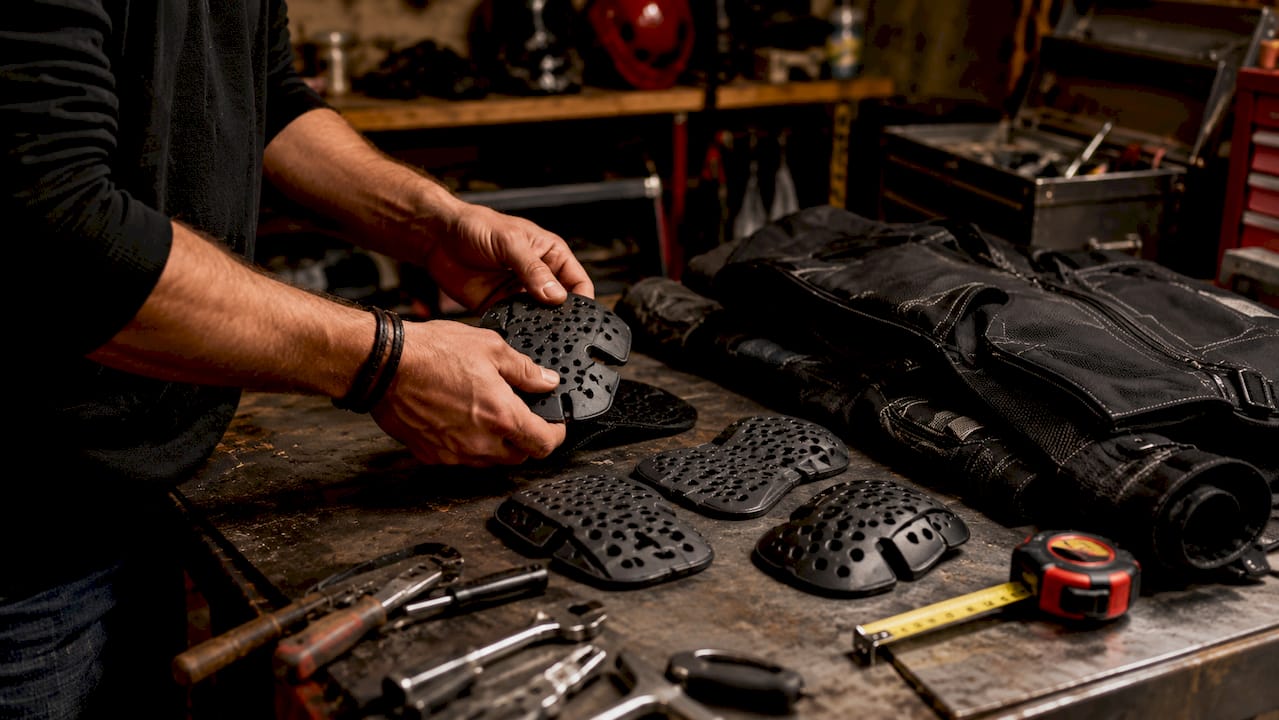
One thing riders often miss: EN 17092 applies to the outer shell of the garment only. It does not cover the armor inserts inside your jacket or pants. Those follow a completely separate certification system, which we will get into next.
How does armor certification differ from apparel shell ratings?
Armor certification is its own world, and it runs parallel to, not inside, the apparel shell rating. The two standards you need to know are EN 1621-1 and EN 1621-2.
EN 1621-1:2012 covers limb armor, meaning the protective inserts for your shoulders, elbows, hips, and knees. EN 1621-2:2014 covers back protectors specifically. Both standards rate armor at two levels, and the difference matters a lot when you are sliding across pavement at 60 mph.
- Level 1: Baseline impact protection. Meets the minimum energy absorption requirement. Adequate for casual and commuter riding.
- Level 2: Superior impact absorption. Level 2 armor absorbs significantly more impact energy than Level 1. Recommended for sport riding, touring, and anyone who takes their safety seriously.
Here is the part that trips up a lot of riders: a jacket can carry a Class AA shell rating while only including Level 1 armor inserts. The jacket label tells you about the fabric. The armor label tells you about the padding. You need to check both. A Class AAA jacket with Level 1 back armor is like wearing a tank hull with a screen door for a window.
Pro Tip: Pull out the armor inserts from any jacket you are considering and look for the EN 1621 label directly on the pad. If there is no label, the armor has not been independently certified, regardless of what the jacket’s hang tag claims.
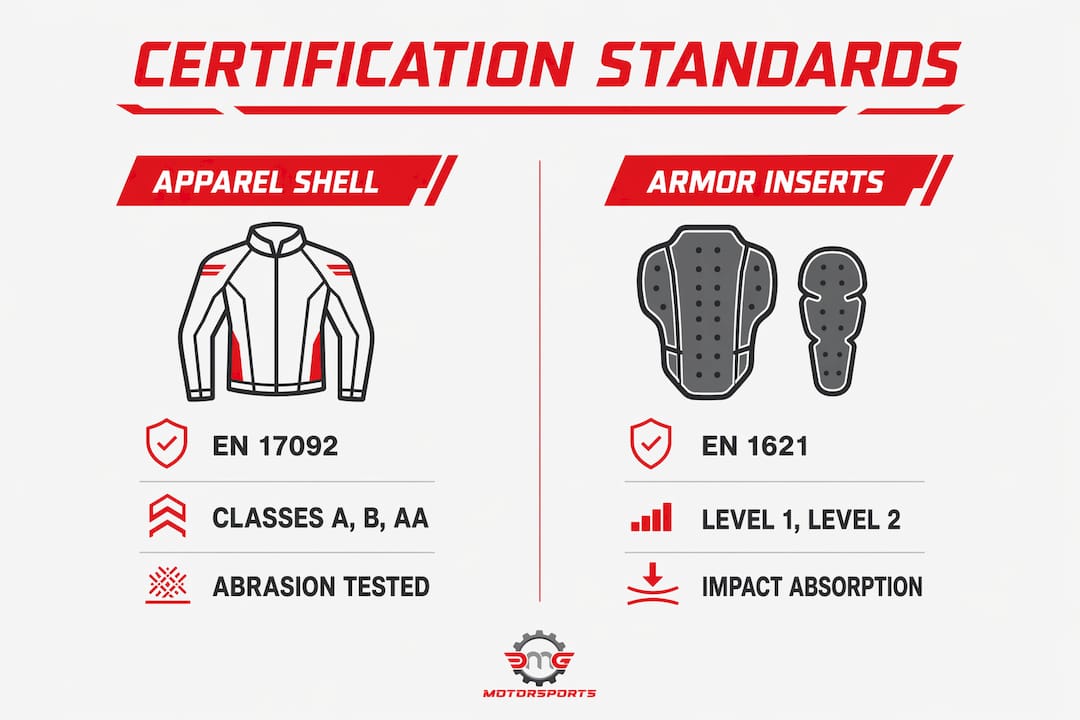
Riders who want full protection should prioritize jackets and pants that combine a high shell rating with Level 2 armor across all impact zones. The apparel certification process for shells and the armor certification process are separate, but together they tell the complete story of how well a garment will protect you.
What are the most common misconceptions about gear certifications?
The biggest misconception in the world of motorcycle gear safety ratings is that ISO 9001 equals safety certification. It does not. ISO 9001 certifies a company’s quality management system, not the crash performance of its products. A factory can hold ISO 9001 certification and produce gear that fails every EN 17092 test. Quality management means the company has consistent processes. It says nothing about whether the jacket will protect you at 45 mph.
Here are the most common certification myths, busted:
- “ISO 9001 means the gear is safe.” Wrong. ISO 9001 is about process consistency, not product safety. CE marking is the safety indicator.
- “No CE mark means no protection.” Not necessarily. Some markets outside the EU use different standards. However, without a recognized certification, you have no independent verification of performance.
- “The CE mark covers everything in the jacket.” The CE mark on the garment label covers the shell. The armor inserts carry their own separate EN 1621 certification labels.
- “All certified gear is equally safe.” Class A and Class AAA are both CE certified. They are not equally protective. The rating level matters as much as the certification itself.
Helmet certification works differently still. The US DOT standard is a self-certification system where manufacturers declare compliance, with government enforcement handled post-market by NHTSA. Apparel certifications under EN 17092 require independent lab testing before the mark is applied. That is a meaningful structural difference in how much trust you can place in each system. For a deeper look at how helmet ratings stack up, the helmet certification breakdown at Dmgmotorsports covers DOT, ECE, Snell, and FIM in detail.
How do you choose the best motorcycle gear using certifications?
Decoding certification labels is a skill, and once you have it, shopping for certified motorcycle clothing becomes a lot less confusing. Here is a practical process for evaluating any piece of gear:
- Find the CE label on the garment. It should list the EN 17092 class (A, AA, or AAA) and the specific body zones covered.
- Remove the armor inserts and check each one. Look for the EN 1621-1 or EN 1621-2 label and confirm whether it is Level 1 or Level 2.
- Match the rating to your riding style. Urban commuters can reasonably use Class AA with Level 1 armor. Sport and track riders should target Class AAA with Level 2 armor across all zones.
- Check for coverage gaps. Some jackets include certified shoulder and elbow armor but ship with a non-certified back protector pocket. That pocket is an invitation to upgrade.
- Factor in fit and comfort. Armor that shifts out of position during a crash provides no protection. A certified jacket that fits poorly is less safe than a lower-rated jacket that stays in place.
Pro Tip: When comparing two jackets at similar price points, prioritize the one with Level 2 back armor. Back injuries are among the most serious crash outcomes, and upgrading a back protector after purchase is easy but often forgotten.
Certifications tell you about crash performance, but they do not tell the whole story of rider safety. ABS reduces collision involvement by approximately 30%, which means the best protection strategy combines certified apparel with active safety technology on your bike. Gear accreditation and bike safety features work together, not in isolation.
| Gear type | Relevant standard | Rating levels |
|---|---|---|
| Jacket or pants shell | EN 17092:2020 | A, B, AA, AAA |
| Limb armor (shoulders, elbows, knees) | EN 1621-1:2012 | Level 1, Level 2 |
| Back protector | EN 1621-2:2014 | Level 1, Level 2 |
| Helmet (EU) | ECE 22.06 | Pass/Fail |
| Helmet (US) | DOT FMVSS 218 | Pass/Fail (self-declared) |
Key Takeaways
Motorcycle apparel certifications require checking both the EN 17092 shell rating and the EN 1621 armor level, because each covers a separate layer of protection.
| Point | Details |
|---|---|
| Shell and armor are separate | A jacket’s CE rating covers the fabric shell only; armor inserts carry their own EN 1621 certification. |
| Rating level matters | Class AAA and Level 2 armor offer significantly more protection than Class A and Level 1. |
| ISO 9001 is not a safety cert | ISO 9001 confirms quality management processes, not crash performance or product safety. |
| Check every armor zone | Some jackets include certified limb armor but omit a certified back protector. Always verify each insert. |
| Combine gear with active safety | Certified apparel and ABS together provide better overall protection than either one alone. |
My honest read on where riders go wrong with certifications
After spending years around motorcycle gear, the pattern I see most often is riders who buy a jacket based on the CE label on the hang tag and never once pull out the armor inserts to check them. The hang tag tells you about the shell. The inserts are where the real variation lives. I have seen Class AA jackets ship with completely uncertified back pads. The jacket passed its tests. The pad never took one.
The ISO 9001 confusion is also real and persistent. Riders see that certification listed on a product page and assume it means the gear is safe. It means the factory has documented processes. That is genuinely useful for consistency, but it is not a crash test. These are two different things, and conflating them is how riders end up with gear that looks credible on paper but has never been independently tested for impact performance.
My honest advice: treat your armor inserts like a separate purchase decision. Even if you love the jacket, if the back protector is not EN 1621-2 Level 2 certified, replace it before your first ride. Back protectors are inexpensive relative to the cost of a spinal injury. Standards will keep evolving, and the gap between Level 1 and Level 2 protection will likely widen as testing methods improve. Buy to the current top standard now, and you will not need to second-guess your gear when the next update drops.
— Bryan
Gear up with Dmgmotorsports: certified protection for every ride
Knowing your certifications is half the battle. Finding gear that actually meets them is the other half.
Dmgmotorsports carries a curated selection of CE certified jackets, pants, gloves, and boots alongside Level 2 armor products from trusted brands. Every product listing reflects the actual certification level so you can shop with confidence instead of guesswork. Whether you are gearing up for daily commutes or weekend sport riding, the full gear catalog at Dmgmotorsports has certified options across every riding style and budget. Our team is rider-first, which means we stock gear we would actually wear, not just gear that looks good in photos.
FAQ
What does CE certified motorcycle clothing mean?
CE certified motorcycle clothing has passed independent safety testing under EU regulation 2016/425 and meets the EN 17092 standard for protective garment shells. The CE mark confirms the gear complies with Personal Protective Equipment requirements for the European market.
What is the difference between Level 1 and Level 2 armor?
Level 1 and Level 2 armor both meet the EN 1621 standard, but Level 2 absorbs significantly more impact energy than Level 1. Level 2 is the recommended choice for sport riding, touring, and any situation where crash forces are likely to be higher.
Does ISO 9001 mean motorcycle gear is safe?
ISO 9001 certifies a manufacturer’s quality management system, not the safety performance of its products. A brand can hold ISO 9001 certification and still produce gear that fails EN 17092 or EN 1621 safety tests.
Are apparel certifications the same as helmet certifications?
No. Motorcycle apparel uses EN 17092 for shells and EN 1621 for armor. Helmets use separate standards such as ECE 22.06 in Europe or DOT FMVSS 218 in the United States. DOT is a self-declaration system, while EN 17092 requires independent lab testing before the mark is applied.
What class of motorcycle jacket should I buy?
Match the class to your riding style. Class AA suits general road and commuter riding. Class AAA is the right choice for sport and track use. Pair whichever shell rating you choose with Level 2 armor inserts for the best overall protection.